
Keratoconus: specialist contact lenses in Stockport
Keratoconus changes the shape of the cornea, so glasses stop giving clear vision. We fit the lenses that bring it back: miniscleral, RGP and hybrid designs, fitted in-house with corneal topography and reviewed by the same optometrist every visit.
A keratoconus clinic, not a referral
Most high street practices refer keratoconus away. We fit it here. Our optometrist Gohar Majid has a special interest in irregular corneas, and complex lens fits are part of an ordinary week at the practice rather than a rare event.
- Miniscleral, RGP and hybrid lenses, including Time XL and Rose K2
- Corneal topography and OCT in the practice, repeated at every review
- Listed as a keratoconus-friendly practice by the UK Keratoconus Self Help and Support Association
- Many of our keratoconus patients travel to Reddish from well outside Stockport
What is keratoconus?
Keratoconus is a condition of the cornea, the clear window at the front of the eye. The cornea becomes thinner and weaker than it should be, and the normal pressure inside the eye pushes it outwards into a cone shape. The cornea does most of the eye’s focusing, so this change distorts the image reaching the back of the eye.
Glasses correct a regular curve. They cannot correct an irregular one. That is why keratoconus vision stays blurred, ghosted or doubled even with a brand new prescription, and why people are often told they have astigmatism that keeps changing before anyone names the condition.
It usually starts in the teens or early twenties and can begin as young as nine. In most people it progresses for around ten years and then settles, although the pattern varies. Both eyes are usually affected, often to different degrees.
Signs to look out for
- Vision that keeps changing, with new glasses that never quite work
- Ghosting, doubling or several faint copies of what you are looking at
- Glare and haloes around lights, especially when driving at night
- Astigmatism that rises at each eye test
- Itchy eyes and a strong urge to rub them
Rubbing matters. Many people with keratoconus also have allergies or dry eyes, and hard rubbing is thought to make the cornea weaker still. If your eyes itch, use a cold compress or press gently without rubbing, and tell us so we can treat the itch.
Types of keratoconus
Where the cornea is thinnest decides how you see. A central cone sits in front of the pupil and blurs vision early, even in a mild case. A low cone, or pellucid marginal degeneration, sits near the bottom edge of the cornea; glasses may work surprisingly well, but ghosting is often worse. Keratoglobus is a rarer, more general thinning across the whole cornea. Our topographer maps all of these, and the map tells us which lens design to reach for first.
How we assess it
Corneal topography maps the front surface of the cornea point by point and shows the cone’s position, height and steepness. OCT of the front of the eye measures corneal thickness and shows the lens sitting on the eye in cross-section. We repeat both at each review, so we can see whether the cornea is stable or still changing and act early if it is not.
Your options
Contact lenses
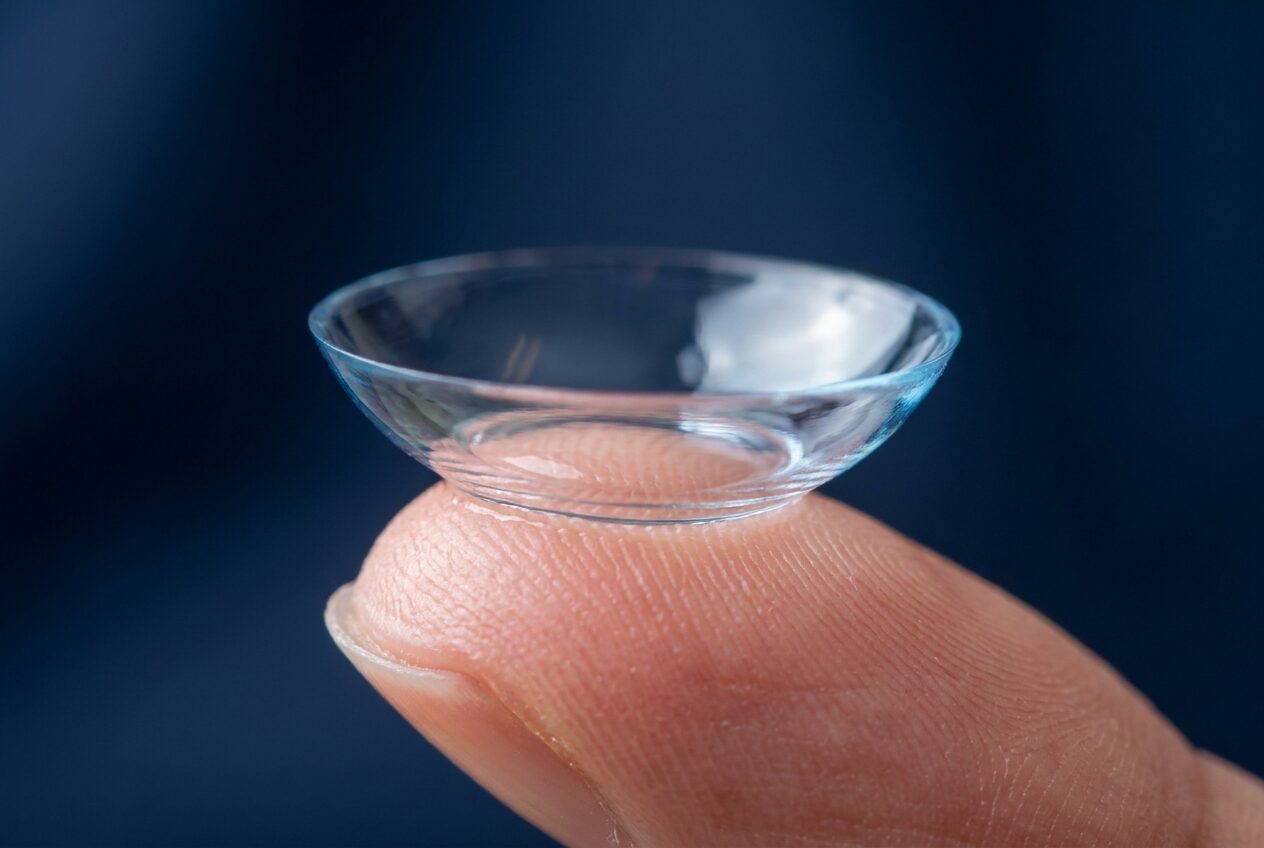
A contact lens creates a new, smooth optical surface in front of the irregular cornea. The layer of tears trapped between the lens and the eye fills in the peaks and troughs, and light can focus properly again. Which lens works best depends on the cone, your prescription, your tear film and your day.
- Miniscleral lenses are our first choice for most moderate and advanced cones. They vault over the whole cornea and rest on the white of the eye, so they are stable, comfortable and never touch the cone itself. Time XL is one of the designs we fit.
- RGP corneal lenses such as Rose K2 are small rigid lenses designed specifically for keratoconus. They give sharp vision and are easy to handle. Comfort takes a little adaptation.
- Hybrid lenses combine a rigid centre with a soft skirt: rigid-lens clarity with soft-lens comfort and stability.
- Specialist soft lenses such as KeraSoft can work well for early or low cones, and for people who cannot tolerate rigid lenses.
- Piggyback fitting places a rigid lens on top of a soft one when comfort is the sticking point.
Ordinary disposable soft lenses can still be fine in early cases, and if you see well in them there is no need to change. Rigid lenses do not slow keratoconus down, whatever you may have read; they correct vision while they are worn and the cornea returns to its own shape when they are out.
Corneal cross-linking
Cross-linking (CXL) is a hospital procedure that strengthens the cornea with riboflavin drops and ultraviolet light. It is the only treatment shown to halt or slow the progression of keratoconus in most people, which is why we watch topography closely in younger patients and refer promptly through the NHS when the cornea is still changing. CXL stabilises the eye; it does not restore the original shape, so most people still need contact lenses afterwards. We fit them once the eye has settled.
Other surgery
Corneal ring segments, implantable lenses and, in advanced cases, a corneal transplant are options your hospital team may discuss with you. We work alongside the hospital and fit lenses after surgery when they are needed, which is often.
What happens at a keratoconus consultation
- We take a full history, including any hospital care, and measure your vision with and without your current correction.
- We map both corneas with topography and scan them with OCT.
- We place trial lenses on the eye and check the fit and the vision with each design.
- Custom lenses are ordered to your measurements, usually within a couple of weeks.
- At collection we teach insertion, removal and care, and check the lenses on the eye.
- Aftercare reviews follow, at first after a few weeks and then at regular intervals, with topography repeated each time.
Fees for the consultation, lenses and aftercare will be published here plainly. Some patients are entitled to NHS help with the cost of specialist lenses through a hospital contact lens service, and complex prescriptions may qualify for an NHS voucher. Ask us and we will explain what applies to you.
Consultation and lens fees: to be confirmed by the practice.
Book a keratoconus consultation
Bring your current glasses and lenses, any hospital letters and, if you have them, previous lens details. Allow an hour.
Or call 0161 432 8101, Monday to Friday, 9:00am to 5:15pm.
Already a lens wearer?
If you have lenses from another practice or a hospital clinic and want them checked, refitted or replaced, we are happy to take over your care. Bring the lenses and any specification you have.
Support
The UK Keratoconus Self Help and Support Association runs a helpline, forums and local meetings, and can advise on work, driving and insurance.
Questions people ask us
I have just been diagnosed. What should I do first?
There are two common routes to a diagnosis. Either your vision has been getting harder to correct and someone has finally named the cause, or a laser clinic has picked up early keratoconus on a screening scan and advised against surgery.
In the first case, the condition is already affecting you and it is worth being fitted with lenses soon so that work, study and driving are not on hold. In the second, the keratoconus may not be affecting your vision at all yet. Take your time, get a proper topography baseline, and let us monitor it. Early cases picked up by screening do not always progress.
Why can’t I just have stronger glasses?
Glasses are designed for a regular corneal shape. Keratoconus distorts the front and back surfaces of the cornea unevenly, and no spectacle lens can be shaped to cancel that out. A contact lens can, because it replaces the irregular surface with a smooth one.
Can I still drive?
Yes, as long as you meet the DVLA vision standard with your lenses in. You should tell the DVLA that you need contact lenses to drive; they simply record it. Some people find night driving hard even with lenses because of haloes and ghosting. If that is you, it is safer not to drive at night, and it is worth telling us because a different lens design may help.
Will I pass it on to my children?
Keratoconus does run in some families and appears to have a genetic component, but many people are the only person in their family with it. There is no test to predict it. What you can do is have your children’s eyes examined regularly from an early age, and ask us to include topography if there is any doubt.
My employer does not understand. What can I say?
Keratoconus is invisible when lenses are in and disabling when they are out, which colleagues can find hard to grasp. We can write a letter explaining your condition and why you need regular appointments. Workplace disability law covers vision, and the UK Keratoconus Self Help and Support Association has good guidance on talking to employers.
Do you take referrals from other opticians?
Yes. Opticians, GPs and hospital clinics refer patients to us for lens fitting, and we are happy to co-manage with your hospital team. There is no need for a referral to book, though; you can simply call.
Is keratoconus linked to dry eye and allergy?
Often. Itchy, dry or allergic eyes are common in keratoconus, and the rubbing they provoke is thought to make the cornea worse. We treat the itch as part of your care, and our Revive Eye Spa dry eye clinic is on hand if a fuller assessment is needed.
Related pages
- Specialist contact lenses the lens designs we fit and how a fitting works
- OCT and our technology corneal topography, OCT and what they show
- Revive Eye Spa for the itchy, dry eyes that so often come with keratoconus
- Emergency eye care sudden pain, redness or a lost lens
Not sure whether we can help?
Call us on 0161 432 8101 and describe what you have been told. We will tell you straight away whether a lens fitting is worth trying.