
Colourimetry and visual stress
If words move, blur or swim on the page, or reading brings on headaches and tired eyes, a coloured overlay or precision-tinted lenses may help. We assess visual stress in children and adults.
What is visual stress?
Visual stress is a sensitivity to the striped pattern that lines of print make on a page. In people who have it, text can appear to move, shimmer, blur or fade, patterns seem to form in the words, and reading for more than a few minutes brings on eye strain or headaches. It affects adults as well as children, and able readers as well as struggling ones.
It is not dyslexia, although the two often occur together, and someone with dyslexia who also has visual stress will find reading harder still. Research led by Professor Arnold Wilkins suggests that a meaningful minority of the population is affected to some degree, and a smaller group severely.
- Words that move, wobble or double on the page
- Headaches or sore eyes when reading
- The page looking too bright, or the print blurring
- Losing your place, skipping lines, reading slowly and tiring quickly
How we assess it
- A full eye examination first, with particular attention to how well the two eyes work together. Focusing and eye coordination problems can cause similar symptoms and need treating first, with glasses or exercises.
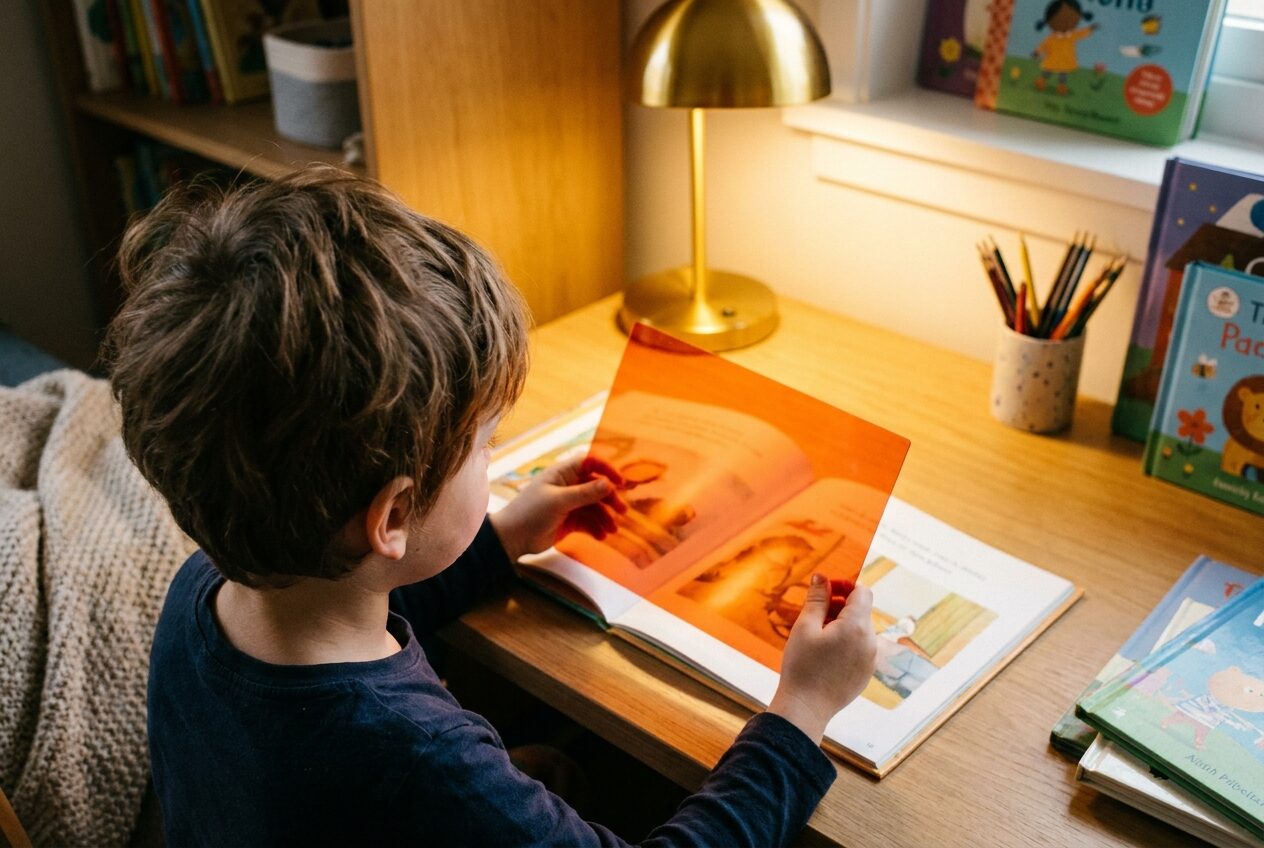
- If symptoms remain, an overlay assessment. You read through acetate sheets of different colours and we record which ones make the print clearer and more comfortable, narrowing down to the best colour or combination.
- A trial with the chosen overlay for reading at home, school or work. For children, we ask parents and teachers to watch reading speed, comfort and how often the overlay is reached for without prompting.
- If the overlay clearly helps, colourimetry. The Intuitive Colorimeter finds the precise tint that suits you, which can then be made into spectacle lenses for reading, board work and screens.
Coloured overlays and tints do not cure dyslexia, and they do not help everyone. What they can do, for the right person, is take the discomfort out of reading and let the effort go where it belongs.
Assessment and lens fees: to be confirmed by the practice.
Book a visual stress assessment
For children, bring a school reading book and any notes from teachers or a specialist. The eye examination for under-16s is NHS-funded; the overlay and colourimetry assessments are private.
Or call 0161 432 8101.
Questions people ask us
My child’s school suggested an overlay. Do we still need an eye test?
Yes, and it should come first. Focusing and eye coordination problems produce the same symptoms as visual stress and are treated differently. An overlay on top of an uncorrected prescription helps nobody.
Can adults have visual stress?
Yes. It often surfaces when someone starts a job or course with a lot of reading, or after a head injury or migraine. The assessment is the same.
Are tinted glasses better than an overlay?
An overlay is a cheap, quick way to find out whether colour helps. Tinted lenses are more precise and work for board work, screens and writing, where an overlay cannot be used. Most people start with an overlay and move to lenses if it clearly helps.
Is it linked to migraine?
There is overlap. Some people with migraine find the same visual discomfort with stripes and text, and precision tints can help some of them. We assess each case on its own.
Related pages
- Children’s eyecare sight tests, vouchers and the Kidz Zone
- Eye examinations the starting point for any reading difficulty
Reading should not hurt.
Book an assessment or call 0161 432 8101 and we will start with a proper eye examination.