
Myopia control for children
Short-sight usually gets worse through childhood as the eye grows. It does not have to get worse as fast. We fit lenses that are designed to slow it down, and we track the result at every visit.
Why slowing myopia matters
A short-sighted eye is a longer eye. Each step up in prescription stretches the retina a little further, and higher levels of myopia carry a higher lifetime risk of retinal detachment, myopic macular degeneration and glaucoma. Slowing the growth while a child is young keeps the final prescription lower and the eye healthier for life.
Ordinary glasses correct the blur but do nothing to slow the growth. Myopia control lenses do both. The earlier we start, the more there is to gain, which is why we like to see children as soon as short-sight first appears, and sooner if a parent is short-sighted.
- Two evidence-based options: EyeDream Ortho-K overnight lenses and MiYOSMART spectacle lenses
- Corneal topography in the practice for fitting and monitoring
- Progress reviewed every six months, with a clear record of how the prescription is changing
- NHS-funded sight tests for under-16s; myopia control itself is a private service
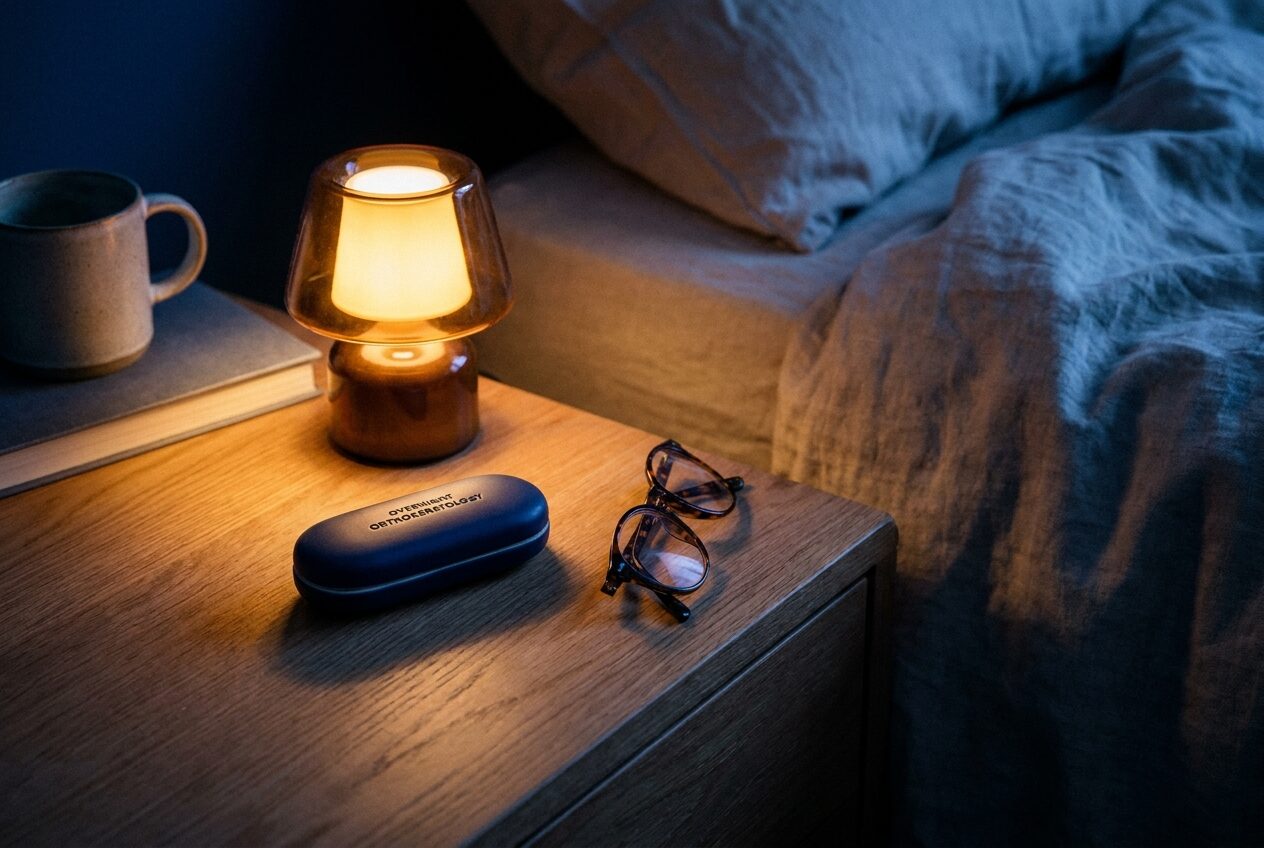
The options we offer
EyeDream Ortho-K
Rigid lenses worn overnight gently reshape the front of the eye. Your child takes them out in the morning and sees clearly all day with no glasses and no daytime lenses. Ortho-K has one of the longest track records in myopia control, and children who play sport or swim tend to love it.
Suitable from around seven or eight, once a child can manage lenses with a parent’s help. More about EyeDream.
MiYOSMART spectacle lenses
Hoya’s MiYOSMART lenses look like ordinary glasses. A ring of tiny lens segments around the central zone changes how light focuses on the peripheral retina, which is the signal that appears to drive eye growth. Nothing to insert, nothing to clean, and suitable from about age six.
In the published two-year trial, children wearing MiYOSMART lenses saw their myopia progress roughly half as fast as children in standard single-vision lenses.
Neither option stops myopia altogether, and results vary between children. What we can do is measure honestly at each review and adjust the plan if a child is not responding as we would hope.
What to expect
- A children’s eye examination, NHS-funded for under-16s, to confirm the prescription and check eye health.
- A myopia assessment: we discuss family history, screen time and time outdoors, map the cornea with topography, and talk through which option suits your child and your family.
- Fitting or dispensing. Ortho-K involves trial lenses and a couple of early morning checks; MiYOSMART is dispensed like any other pair of glasses.
- Reviews every six months. We remeasure, compare against the previous visit, and show you the trend.
Alongside lenses, two habits are worth building for any short-sighted child: at least two hours a day outdoors in daylight, and regular breaks from close work and screens.
Assessment, lens and review fees: to be confirmed by the practice.
Book a myopia assessment
Bring your child’s current glasses and any previous prescriptions. We can usually combine the assessment with an NHS sight test.
Or call 0161 432 8101.
Is your child short-sighted?
Sitting close to the television, squinting at the board, holding books close and headaches after school are all worth a sight test. Children rarely complain, because blur is all they have known.
Questions parents ask us
Is Ortho-K safe for children?
Ortho-K is a well-established treatment with a good safety record when lenses are fitted properly and cared for properly. The main risk with any overnight lens is infection, which is rare and almost always linked to poor hygiene. We teach the routine carefully, review often, and we would rather you rang us with a small worry than sat on it.
At what age can we start?
MiYOSMART lenses from about six. Ortho-K from about seven or eight, depending on the child; some younger children manage well with a parent doing the handling. There is no upper limit, but the biggest benefit comes from starting when myopia first appears.
Does it hurt?
No. MiYOSMART is simply a pair of glasses. Ortho-K lenses are worn with the eyes closed, so most children barely notice them, and the eye feels normal on waking.
My child already wears glasses. Is it too late?
No. Slowing further progression is worthwhile at any point during childhood. Bring the current prescription and we will show you how it has been changing.
How do you know it is working?
We compare the prescription, and the corneal maps, against the previous visit and against the rate of change before treatment. You see the numbers at every review.
Does the NHS pay for myopia control?
The sight test is NHS-funded for children, and the NHS voucher can go towards standard glasses. Myopia control lenses are a private service. We publish fees plainly so you can decide with the numbers in front of you.
Sources
- Lam CSY, Tang WC, Tse DY et al. Defocus Incorporated Multiple Segments (DIMS) spectacle lenses slow myopia progression: a 2-year randomised clinical trial. British Journal of Ophthalmology 2020;104:363-368.
- Bullimore MA, Brennan NA. Myopia control: why each diopter matters. Optometry and Vision Science 2019;96:463-465.
Related pages
- EyeDream Ortho-K overnight lenses in detail
- Children’s eyecare NHS sight tests, vouchers and the Kidz Zone
- Eyewear frames for children, and MiYOSMART lenses
Worried your child’s prescription keeps rising?
Book a myopia assessment or call 0161 432 8101 and we will explain the options without any pressure.